 PrysmScanner
Short answer
The Prysm Score is the number Nu Skin's Prysm iO gives after a 15 second fingertip scan. It reflects the carotenoid antioxidants in your skin, which come from colourful fruit, vegetables and supplements. You raise it over weeks by eating more carotenoid rich food, supplementing, not smoking and managing stress and sleep.
What the score measures
Carotenoids are the yellow, orange and red pigments in plants. Beta carotene, alpha carotene, lycopene, lutein and zeaxanthin are the best known. Your body cannot make them, so the amount in your skin reflects what you eat and absorb. They also act as antioxidants, which is why skin carotenoid levels are used as a marker of antioxidant status.
Prysm iO reads those pigments optically through the fingertip and turns more than 70,000 light absorption measurements into one number. Nu Skin calls the measurement method Spectral Rai technology.
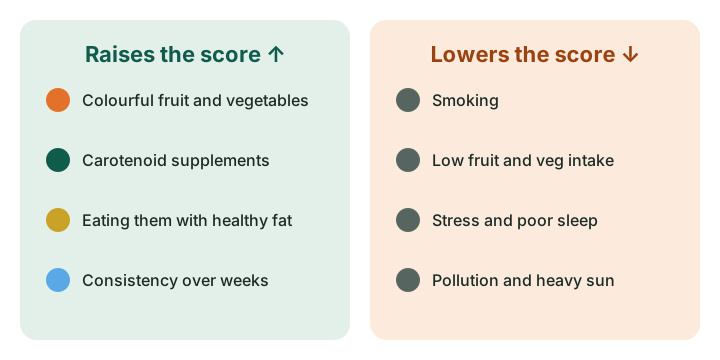
What pushes your score up or down
| Tends to raise it | Tends to lower it |
|---|---|
| Deeply coloured fruit and vegetables every day | Smoking |
| Eating carotenoid foods with some fat (olive oil, avocado, nuts) | Low fruit and vegetable intake |
| Carotenoid containing supplements | Ongoing stress and poor sleep |
| Consistency over weeks | Heavy pollution and sun exposure |
How to raise your Prysm Score
- Add colour to every meal. Carrots, sweet potato, pumpkin, tomatoes, red peppers, spinach, kale, broccoli, mango, apricots and papaya are all rich in carotenoids.
- Add a little fat. Carotenoids are fat soluble. A drizzle of olive oil on salad or cooked tomatoes helps absorption.
- Cook some of it. Lightly cooking tomatoes and carrots makes lycopene and beta carotene easier to absorb.
- Consider a certified supplement. Nu Skin certifies supplements such as LifePak, g3, Beauty Focus Collagen+ and ageLOC Youth as clinically shown to raise the Prysm Score.
- Stop smoking. Smokers consistently show lower carotenoid levels.
- Rescan in 4 to 8 weeks. Skin carotenoids move slowly, so give changes time to show.
How to read your results over time
Treat the first scan as your baseline. The trend matters more than any single number. In a Nu Skin study of 46 adults, people taking carotenoid supplements saw skin carotenoid levels rise 43 to 46% after 12 weeks.
More questions about the score
What is a good Prysm Score?
The device shows your result as a number and a colour zone, and the app tells you which zone you are in. The most useful comparison is with your own earlier scans. A rising score over 6 to 12 weeks tells you your routine is working.
Why did my Prysm Score not change after a week?
Carotenoids build up in the skin slowly. Changes usually show over several weeks, so rescan after 4 to 8 weeks rather than every few days.
Can my skin tone affect the score?
Research on optical skin carotenoid devices in general shows more variation in readings at higher skin melanin levels, even though melanin is not supposed to interfere. Tracking your own trend on the same device is the most reliable way to read your results.