 PrysmScanner
Short answer
The most practical way to check your antioxidant status is to measure carotenoids, the antioxidant pigments from fruit and vegetables. You can do that with a lab blood test, or non invasively with a skin scanner such as Nu Skin's Prysm iO, which reads the fingertip in about 15 seconds.
Why carotenoids are the marker
There is no single test for every antioxidant in the body. Carotenoids are the best studied marker because they come only from diet, they act as antioxidants, and they can be measured accurately in both blood and skin. Higher levels mean a diet richer in colourful plants.
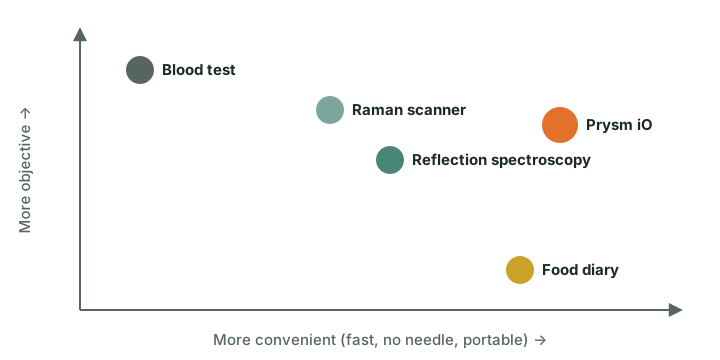
The five methods
| Method | How it works | Time | Best for |
|---|---|---|---|
| Blood test (plasma carotenoids) | Blood draw analysed in a lab, usually by HPLC | Days | Clinical research reference |
| Resonance Raman scanner | Blue laser light on the palm (e.g. Pharmanex BioPhotonic Scanner) | Seconds | Earlier generation scanning |
| Reflection spectroscopy | White light and finger pressure (e.g. Veggie Meter) | Short scan | Nutrition research |
| Prysm iO | Hyperspectral absorption plus AI at the fingertip | About 15 s | Clinics and personal tracking |
| Food diary or questionnaire | You record what you eat | Days | Habits, not levels |
How the methods compare
Blood tests are the reference, but they are invasive, slower and move with your last few meals and the season.
Skin scanners reflect intake over recent weeks, need no needle, and are fast enough to repeat often. Raman measurements correlate with plasma carotenoids at about r = 0.62 and with skin biopsy carotenoids at about r = 0.66 in published work. Reflection spectroscopy devices have shown correlations around r = 0.81 with plasma. Nu Skin reports a strong correlation between Prysm iO and blood carotenoids.
Food diaries are useful for habits, but people misremember. In one study, self reported fruit and vegetable intake was not significantly linked to measured carotenoids.
How to start
- Get a baseline scan.
- Change one thing: more colourful vegetables, a carotenoid supplement, or quitting smoking.
- Rescan after 4 to 8 weeks and compare.
Common questions
Is there a home test for antioxidant levels?
Yes. Fingertip skin carotenoid scanners such as Prysm iO give a reading in about 15 seconds without blood. They measure carotenoid antioxidants, which are the most studied marker of antioxidant intake from food.
Is a blood test more accurate than a skin scan?
Blood plasma carotenoids measured in a lab are the reference standard, but they swing with recent meals and the season. Skin carotenoids change more slowly, so they reflect your intake over recent weeks. That makes skin scanning practical for tracking a trend.
What is the best marker of fruit and vegetable intake?
Carotenoids in the blood or skin are the most widely used objective markers. Food questionnaires are much weaker. In research, self reported intake often correlates poorly with measured carotenoids.
Sources
- Jilcott Pitts et al.: reflection spectroscopy validity vs plasma carotenoids (PMC8754514)
- Vegetable enriched bread pilot study, Veggie Meter vs plasma (PMC10261728)
- Br J Nutr 1996: carotenoid intake vs plasma levels in UK women
- Nu Skin Help Centre: What is the BioPhotonic Scanner?
- Nu Skin press release, 2 Apr 2026: Nu Skin Launches Prysm iO